
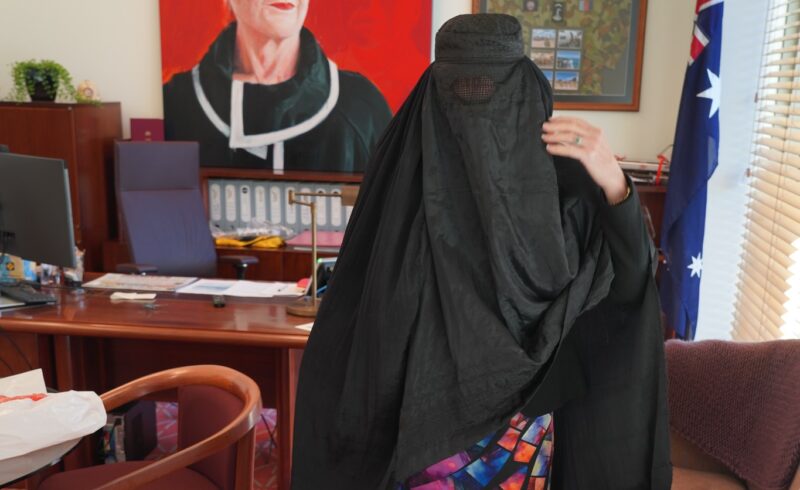

Sydney/London, Nov 25: The Australian Senate has suspended One Nation leader Pauline Hanson for one week after she entered the chamber wearing a burka in an attempt to revive her long-standing demand for a nationwide ban on full-face coverings.
Hanson’s act on Monday drew sharp condemnation across party lines, with several lawmakers calling it racist, inflammatory, and deeply disrespectful to Muslim Australians. The Senate later passed a formal motion censuring her for the protest.
Stunt sparks outrage across political spectrum
Independent senator Fatima Payman described the act as “disgraceful,” while Greens senator Mehreen Faruqi accused Hanson of “blatant racism.” Faruqi, who won a racial discrimination case against Hanson last year in a Federal Court ruling the One Nation leader is now appealing, said the stunt deliberately targeted Muslim communities.
Foreign Minister Penny Wong, who leads the government in the Senate, moved the censure motion, stating that Hanson “has been parading prejudice as protest for decades.”
The motion — passed overwhelmingly by 55 votes to 5 — concluded that Hanson’s actions were intended to mock and vilify people on the basis of religion and were “disrespectful to Muslim Australians.”
Wong added that Hanson’s behaviour was “not worthy of a member of the Australian Senate.”
Hanson defends action after bill rejected
Hanson wore the burka immediately after senators blocked her from introducing a bill to outlaw full face coverings in public spaces. She has repeatedly pushed for such legislation, arguing it is necessary for security reasons.
Posting on Facebook after the uproar, she wrote: “If they don’t want me wearing it – ban the burka.”
This is not the first time Hanson has worn a burka inside parliament. In 2017, she entered the Senate chamber in full covering as part of a similar protest calling for a national ban.
Long history of controversial remarks
Hanson, known for her anti-immigration stance, has made several contentious statements over the years. In her maiden Senate speech in 2016, she warned that Australia risked being “swamped by Muslims.”
The remarks echoed her infamous 1996 maiden speech in the House of Representatives, in which she claimed the country was in danger of being “swamped by Asians.”
Her recent actions have reignited debate over Islamophobia, race politics, and the responsibilities of elected representatives in Australia’s multicultural society.