





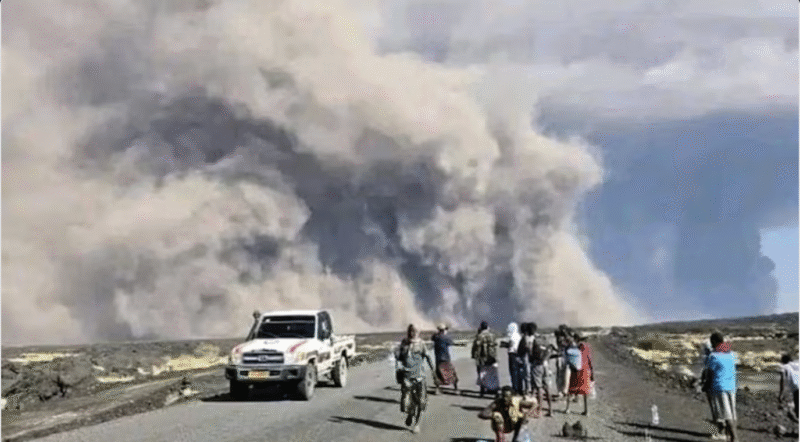

New Delhi, Nov 25: A major volcanic eruption in Ethiopia has triggered aviation alerts across East Africa, prompting Indian authorities and airlines to closely monitor the situation due to the potential risk of volcanic ash drifting into international flight corridors linking India with Europe and Africa.
According to early assessments from global aviation monitoring networks, the eruption—reported in Ethiopia’s Rift Valley region—released a large plume of volcanic ash into the upper atmosphere. Such ash clouds pose serious threats to aircraft engines, navigation systems, and visibility, often leading to large-scale route diversions or cancellations.
Possible impact on India-bound and outbound flights
A significant portion of long-haul flights from India to Europe, the US, and Africa fly over or near East African airspace. Indian carriers including Air India, IndiGo, and Vistara, as well as international airlines operating to Indian cities, may need to alter their routes if the ash cloud spreads along major aviation corridors.
Senior officials in India’s Directorate General of Civil Aviation (DGCA) said they are in continuous touch with global meteorological agencies and are evaluating real-time satellite imagery.
“At present, no Indian flight operations have been affected. However, depending on the movement of the ash plume, advisories may be issued for route changes or altitude adjustments,” an official said.
Why volcanic ash is dangerous for aircraft
Volcanic ash can melt inside aircraft engines, causing them to stall mid-air. It also damages cockpit windows, clogs ventilation systems, and interferes with instruments that pilots rely on during long-haul flights. Even a minor encounter can force emergency landings and expensive aircraft repairs.
Aviation experts say eruptions in East Africa are especially concerning because the region sits near key international airways.
“If the ash cloud moves west or north, it could impact flights from India to Europe. If it drifts east, Indian Ocean routes to Africa and the Middle East could also face disruptions,” an aviation analyst said.
Airlines preparing contingency plans
Several airlines operating between India and Africa, including Kenya Airways, Ethiopian Airlines, and Air India, are reportedly preparing alternate routes. Ground operations teams in Delhi, Mumbai, Bengaluru, and Hyderabad have been advised to remain alert for sudden schedule changes.
Passengers travelling to East Africa, Europe, or North America via African airspace have been advised to check updates from their airlines.
India’s MET division also monitoring
The Indian Meteorological Department (IMD) is tracking the ash movement in coordination with the Volcanic Ash Advisory Centres (VAAC).
Officials say the next 24–48 hours are crucial, as wind patterns will determine whether the plume disperses harmlessly or moves into busy aviation traffic lanes.
No cancellations yet, but caution advised
As of now, flight operations remain normal, but authorities emphasised that decisions may change quickly depending on ash density and movement.
The eruption comes at a time when winter travel is picking up, raising concerns about possible delays for outbound students, business travellers, and holiday passengers.