

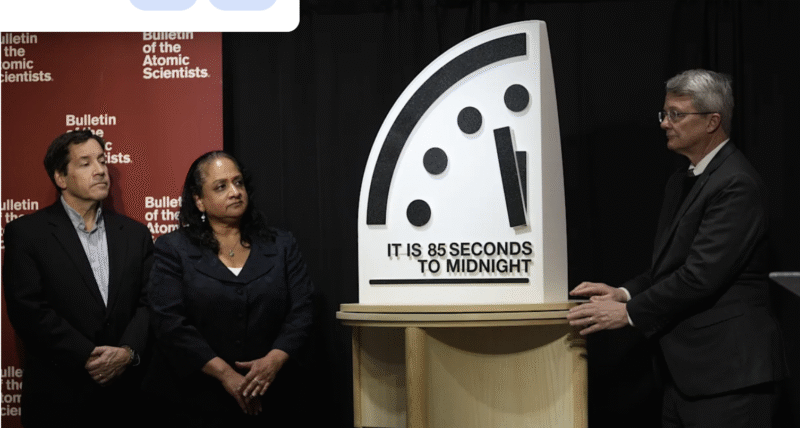

The Doomsday Clock has moved to just 85 seconds before midnight, marking the closest humanity has ever been to global catastrophe, according to scientists from the Bulletin of the Atomic Scientists. The update reflects growing concerns over nuclear threats, climate change, geopolitical instability, and emerging technologies that could pose existential risks to human civilization.
The symbolic clock, created in 1947, is designed to communicate how close the world is to a man-made disaster. Midnight represents global annihilation. The latest adjustment underscores what experts describe as a period of unprecedented danger.
Why the Doomsday Clock Was Moved
Scientists cited multiple, compounding threats behind the decision to move the clock closer to midnight. Chief among them are escalating nuclear risks driven by armed conflicts, the erosion of international arms control agreements, and rising tensions between nuclear-armed states.
Climate change also played a major role. Researchers warned that insufficient global action to reduce greenhouse gas emissions has increased the likelihood of severe environmental disruption, extreme weather events, and long-term threats to food and water security.
In addition, experts highlighted concerns over emerging technologies, including artificial intelligence and biotechnology, which are advancing faster than global governance frameworks designed to manage their risks.
Nuclear Threats and Global Instability
The Bulletin emphasized that the risk of nuclear weapons use—whether by miscalculation, accident, or escalation—remains alarmingly high. Ongoing wars and deteriorating diplomatic relationships have weakened safeguards that once helped prevent catastrophic outcomes.
Scientists warned that misinformation, cyber warfare, and attacks on democratic institutions further heighten the risk of global instability, making coordinated international responses more difficult.
Climate Change and Technological Risks
Climate scientists involved in the assessment stressed that global efforts to curb climate change are falling short of what is needed to avoid the most dangerous impacts. Rising global temperatures, melting ice caps, and biodiversity loss are already contributing to humanitarian crises worldwide.
At the same time, rapid advances in artificial intelligence and biological research present both opportunities and dangers. Without strong oversight, these technologies could amplify existing risks or create new ones with global consequences.
A Warning, Not a Prediction
The Bulletin of the Atomic Scientists emphasized that the Doomsday Clock is not a forecast but a warning. Its purpose is to spark public discussion and encourage world leaders to take decisive action to reduce existential threats.
Experts called for renewed international cooperation, stronger arms control agreements, accelerated climate action, and responsible governance of emerging technologies.
“The clock is a metaphor,” the organization noted, “but the dangers it represents are very real.”
As the clock moves ever closer to midnight, scientists warn that the choices made by governments and societies in the coming years will determine whether humanity steps back from the brink—or moves closer to irreversible catastrophe.