
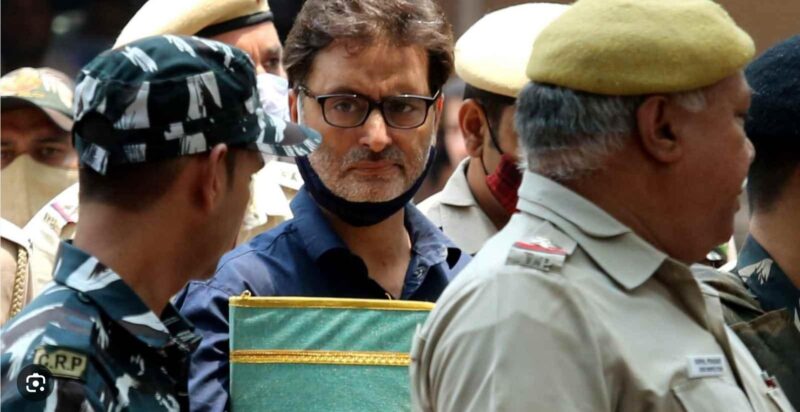

Muhammad Yasin Malik, a prominent separatist leader from Jammu and Kashmir and the former chairman of banned outfit, Jammu and Kashmir Liberation Front (JKLF), is currently facing trial in 1989 killing of Indian Air Force (IAF) personnel in Srinagar.
In a latest significant development in the case, a key accused turned witness has reportedly identified Yasin Malik as the main shooter involved in the attack that had left four IAF personnel dead.
This testimony is considered crucial for the prosecution and may have a major impact on the ongoing trial.
The court continues to hear the case, and further proceedings will determine how this new testimony influences the final outcome.
Who is Yasin Malik
Yasin Malik rose to prominence in the late 1980s as one of the early faces of the militant insurgency in Kashmir. Malik later renounced violence and shifted to a political, non-violent movement in the 1990s, becoming a well-known separatist figure in the Valley.
For decades, he remained a central figure in separatist politics and was involved in various political campaigns, shutdown calls, and negotiations.
Engagements With Indian Prime Ministers
Despite his separatist stance, Yasin Malik remained deeply involved in political dialogue processes, especially during periods when the Union government attempted outreach in Kashmir.
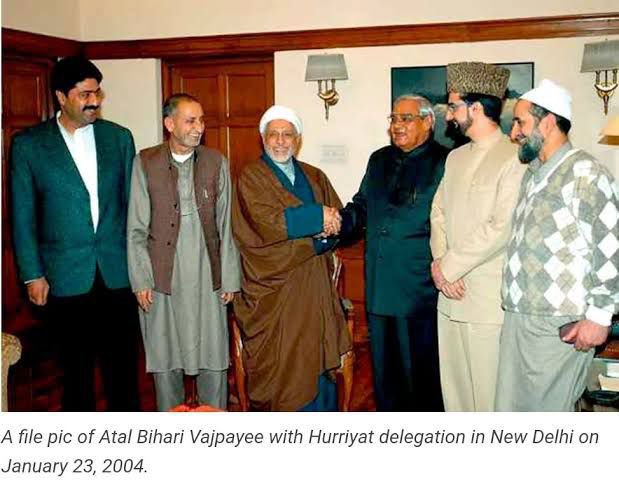
Meeting with Prime Minister Atal Bihari Vajpayee
During Prime Minister Atal Bihari Vajpayee’s tenure, the Centre adopted a “healing touch” and dialogue-focused approach toward Kashmir. As part of this initiative, multiple separatist leaders, including Malik, were engaged informally. Malik was part of delegations and discussion groups exploring political resolutions, cross-LoC interaction, and demilitarisation proposals. His engagement during this period was seen as a sign of his shift toward non-violent political activism.
Interaction with Prime Minister Manmohan Singh
Under Prime Minister Manmohan Singh, the Government of India launched several rounds of talks with separatist groups, including the All Parties Hurriyat Conference factions. Malik participated in structured dialogue sessions and Track-II engagements, focusing on confidence-building measures, the return of displaced families, and easing travel restrictions across the Line of Control. His meetings with Singh’s team were viewed as part of a broader peace initiative.

Meetings During Prime Minister Narendra Modi’s Tenure
In the initial years of the Modi government, Malik—along with other separatist leaders—continued limited engagement, mostly via back-channel interactions. However, after 2016, the government adopted a tough stance toward separatist groups. Dialogue channels closed, and by 2019, with major cases reopened and arrests made under the UAPA, all political engagement between Malik and the Central government effectively ended.
What Is Yasin Malik Accused Of?
Yasin Malik faces several serious criminal cases connected to militancy-related activities dating back to the late 1980s and early 1990s. The major cases include:
1. Terror-Funding Case (NIA)
Malik was convicted in a terror-funding case in 2022 by an NIA court in Delhi.
He pleaded guilty to charges involving funding terror activities, criminal conspiracy, and waging war against the state.
He was sentenced to life imprisonment, which he is currently serving.
2. Rubaiya Sayeed Kidnapping Case (1989)
Malik is accused of involvement in the abduction of Rubaiya Sayeed, daughter of then Union Home Minister Mufti Mohammad Sayeed.
The case was reopened by a special TADA court, and Rubaiya Sayeed herself identified Malik in court as one of the abductors.
3. Killing of IAF Personnel (1989)
Malik is also an accused in the killing of four Indian Air Force personnel in Srinagar in 1989.
The case involves charges of murder, criminal conspiracy, and terrorism.
Key Revelations from His Recent Affidavit
In an affidavit submitted to the Delhi High Court on August 25, 2025, Yasin Malik made several explosive claims. Here are some of the major points:
- Back-Channel Engagements with Indian Government & Intelligence
- Malik said that for about 25 years, successive Indian governments honoured a “ceasefire understanding” with him after he renounced violence in 1994, reported Hindustan Times.
- He claims that he had closed-door meetings with top government and intelligence officials, and that his peace role was more than symbolic, as per Hindustan Times
- According to him, many of his cases were kept in abeyance (“not pursued”) in return for his cooperation, as part of this understanding, as per the report.
- Meeting with Hafiz Saeed
Malik alleges that Indian intelligence officials asked him to meet Lashkar-e-Taiba (LeT) leader Hafiz Saeedin Pakistan in 2006, as part of a covert peace effort, as per NDTV.
He says when he returned and debriefed, then Prime Minister Manmohan Singh personally thanked him for his “efforts, time, patience, and dedication,” as per the report
In his affidavit, Malik also describes a meeting with senior IB officers including Special Director V. K. Joshi prior to his trip, as per NDTV.
Religious and Ideological Ties
In his affidavit, Malik also describes recent history: he claims that during the emergence of Hizbul Mujahideen commander Burhan Wani, the security establishment could have arrested him multiple times but chose not to, suggesting some intelligence complicity or inertia.
Malik claims that two Shankaracharyas (Hindu monastic leaders) visited his Srinagar residence “umpteen number of times” and even held press conferences with him.
He says he once had a five-hour meeting with RSS leaders at the India International Centre in Delhi, organized by a think tank.
Burhan Wani and Intelligence Failures