

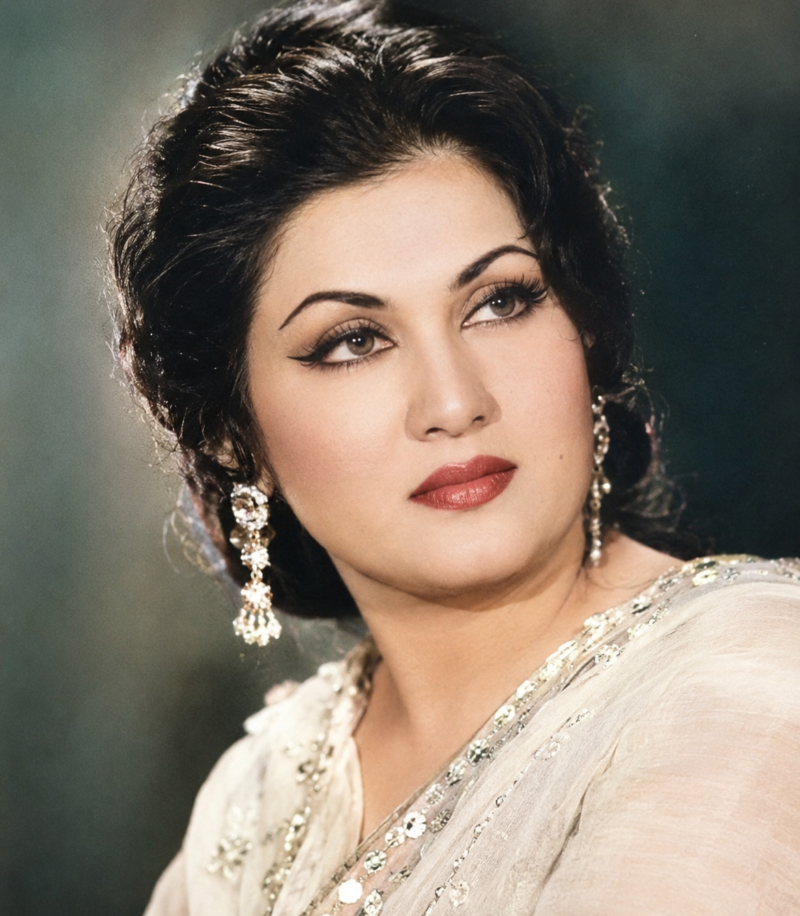

A century after her birth, the voice of Noor Jehan continues to resonate across South Asia. Born on September 21, 1926, in Kasur, Punjab, the legendary singer and actress, popularly known as Malika-e-Tarannum (Queen of Melody), remains one of the most influential voices in the musical history of the subcontinent.
As Noor Jehan’s 100th birth anniversary is observed today, her extraordinary journey—from a child performer in undivided India to one of the most celebrated singers of Pakistani cinema—continues to attract audiences across generations.
Born Allah Wasai into a family of musicians, Noor Jehan was introduced to music at a very young age. She began her career as a child singer and performer in Calcutta before establishing herself as an actor and singer in pre-Partition Indian cinema.
From child star to cinematic icon
Noor Jehan’s early career unfolded during the formative years of Indian cinema. She appeared in several films before gaining wider recognition with movies such as Khandaan, Zeenat, Anmol Ghadi and Jugnu. Her powerful voice and commanding screen presence soon made her one of the prominent stars of the era.
After Partition in 1947, Noor Jehan moved to Pakistan and continued her career in the emerging Pakistani film industry. In 1951, she made her directorial debut with Chann Wey, becoming the first female film director in Pakistan, while also acting and singing in the film. Her subsequent work included films such as Dupatta, Intezar, Anarkali and Koel.
Her career eventually shifted increasingly towards playback singing, allowing her voice to become a defining presence in Pakistani cinema.
Thousands of songs, several languages
Over a career spanning more than six decades, Noor Jehan recorded thousands of songs in languages including Urdu, Punjabi and Sindhi. Pakistani state media and other sources commonly put the figure at around 10,000 recordings, reflecting the extraordinary scale of her musical career.
She was equally associated with film songs, ghazals and classical-influenced music. Her distinctive ability to combine classical training with dramatic expression gave her recordings a signature quality that helped establish her as the Malika-e-Tarannum.
Her influence was not confined to Pakistan. Noor Jehan’s work in pre-Partition Indian cinema and her continuing popularity across the region made her one of the artists whose career reflected the shared cultural history of the subcontinent.
The voice of 1965
One of the most remembered chapters of Noor Jehan’s career came during the 1965 India-Pakistan war, when she recorded a series of patriotic songs that became closely associated with Pakistan’s wartime cultural memory.
Songs performed by Noor Jehan during the period were widely broadcast and became symbols of national morale in Pakistan. She was subsequently recognised with major honours for her contribution to music and culture.
A legacy that outlived an era
Noor Jehan received several major honours during her lifetime, including the Pride of Performance, Tamgha-e-Imtiaz and Sitara-e-Imtiaz, along with lifetime achievement recognitions. Her contributions extended beyond singing to acting, filmmaking and the wider development of South Asian popular culture.
She died in Karachi on December 23, 2000, at the age of 74.
Yet her death did little to diminish her presence. Her songs continue to be heard on radio, television, digital platforms and in musical performances across the region.
Noor Jehan at 100
Noor Jehan’s centenary is more than a commemoration of an individual artist. It is also a reminder of a musical era when cinema, classical traditions, poetry and popular culture were deeply intertwined.
From the studios of pre-Partition India to the rise of Pakistani cinema, Noor Jehan witnessed and helped shape some of the most significant transitions in South Asian entertainment.
A hundred years after her birth, the Queen of Melody remains a defining voice of the subcontinent—one whose music continues to cross generations, languages and borders.