

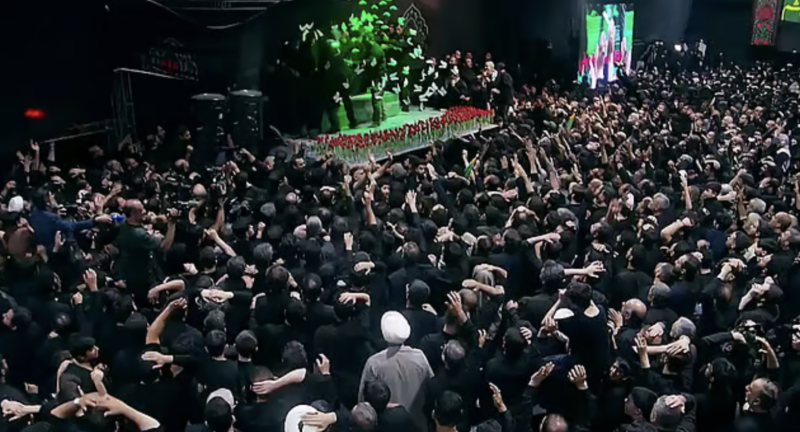

Tehran, July 3: Iran on Friday began the state funeral ceremonies for former Supreme Leader Ayatollah Ali Khamenei, more than four months after his death in a US-Israeli strike, with processions in Tehran expected to be followed by ceremonies in Qom and his burial in the northeastern holy city of Mashhad on July 9. Millions of mourners are expected to participate in what Iranian authorities describe as one of the largest funerals in the country’s history.
The unusually long gap between Khamenei’s death on February 28 and his burial has prompted questions because Islamic tradition generally encourages the prompt burial of the deceased, often within 24 hours where circumstances permit.
Why was the funeral delayed?
Iranian authorities and state media have cited several reasons for postponing the funeral:
- Ongoing war and security risks: The funeral originally planned for early March was postponed as Iran remained engaged in conflict following the strikes that killed Khamenei. Officials said holding a massive public gathering during active hostilities posed unacceptable security risks.
- Large-scale state funeral planning: Authorities decided to organize a multi-city funeral spanning Tehran, Qom and Mashhad, with additional commemorative events in Iraq’s Shiite holy cities. The elaborate arrangements required months of logistical planning.
- Muharram observances: Tehran Mayor Alireza Zakani said the funeral was also deferred so it would not overlap with the first ten days of Muharram, when Shiite Muslims commemorate the martyrdom of Imam Hussein. Officials argued that allowing Ashura observances to conclude before the state funeral was religiously appropriate.
- Expected record attendance: Iranian officials expect tens of millions of mourners and delegations from dozens of countries. The extended preparations were also intended to accommodate the anticipated crowds and security arrangements.
How has Iran justified the delay in Islamic terms?
Islamic jurisprudence generally recommends that burial take place as soon as reasonably possible. Several authentic hadiths encourage believers not to delay funeral rites, while the Qur’an emphasizes honoring the dead but does not prescribe a fixed time limit for burial.
Classical Islamic scholars, across different schools of thought, have also recognized exceptions when immediate burial is not possible because of war, public safety, transportation difficulties, legal investigations or other compelling circumstances.
Iranian officials have argued that the delay falls within these exceptional circumstances because of:
- active military conflict,
- extraordinary security threats,
- the need to protect mourners,
- and the desire to conduct a nationwide state funeral befitting the country’s highest political and religious authority.
Reports citing Iranian officials also state that Khamenei’s remains were preserved under appropriate conditions until the official funeral could be held, although authorities have rejected speculation circulating on social media that he had already been secretly buried.
Massive security arrangements
Security has been significantly tightened for the funeral. Iranian military leaders have warned the United States and Israel against any action during the ceremonies, while airspace restrictions and heightened security measures have been imposed around major venues.
The funeral is expected to conclude on July 9, when Khamenei will be buried at the Imam Reza shrine in Mashhad, one of the holiest sites in Shiite Islam.