


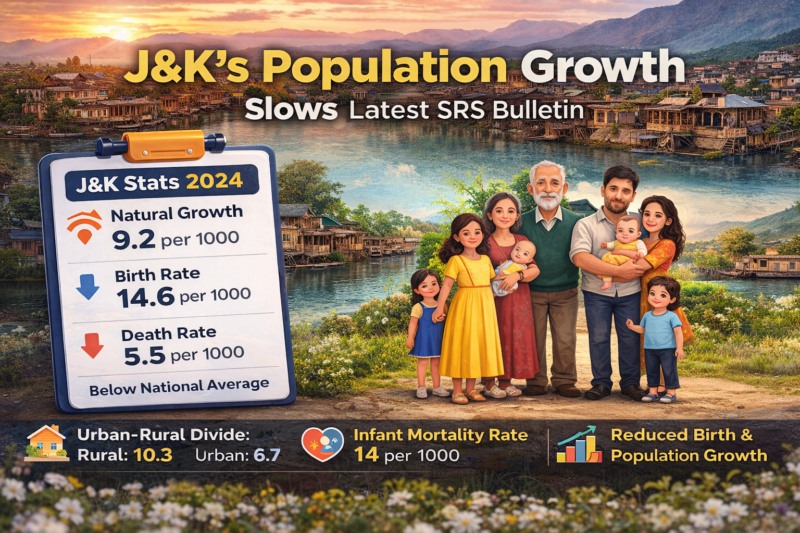

Srinagar, May 21: Jammu and Kashmir’s population growth rate has continued to decline, with the Union Territory recording a natural growth rate of 9.2 per 1000 population in 2024, according to the latest Sample Registration System (SRS) Bulletin released by the Registrar General of India.
The figure is significantly lower than the national average of 11.9, indicating that J&K is steadily moving towards slower population growth due to declining birth rates and comparatively lower mortality levels.
As per the SRS Bulletin, J&K’s birth rate for 2024 stands at 14.6 per 1000 population, well below India’s average birth rate of 18.3. The death rate in the Union Territory has been recorded at 5.5, compared to the national average of 6.4.
The difference between the birth rate and death rate gives J&K a natural growth rate of 9.2, placing it among regions with moderate population growth trends.
The report noted that J&K’s growth rate remains considerably lower than several northern Indian states, including Bihar (20.8), Uttar Pradesh (17.2), Rajasthan (17.0), and Madhya Pradesh (15.8). However, the Union Territory still records a higher growth rate than states such as Kerala (3.9), Tamil Nadu (4.8), and Punjab (6.5), which are further advanced in demographic transition.
The bulletin also highlighted a notable rural-urban divide in population growth patterns across Jammu and Kashmir.
Rural areas of J&K recorded a natural growth rate of 10.3, while urban areas registered a much lower rate of 6.7. Experts say this reflects faster demographic transition in towns and cities, driven by changing lifestyles, delayed marriages, better healthcare access and increased awareness of family planning.
Among larger states and Union Territories, urban J&K recorded the fifth-lowest natural growth rate in the country. Only Kerala, West Bengal, Tamil Nadu and Odisha reported lower urban growth figures.
The SRS Bulletin further showed improvement in Jammu and Kashmir’s infant mortality indicators. The Infant Mortality Rate (IMR) in 2024 stood at 14 deaths per 1000 live births, significantly lower than the national average of 24.
Urban areas recorded an IMR of 12, while rural areas reported a slightly higher rate of 15. Health experts believe the decline reflects improvements in maternal and child healthcare services across the region.
Demographers say the slowing population growth in J&K could have major long-term social and economic implications. Reduced growth is expected to ease pressure on land, infrastructure, public services and employment opportunities in a region already constrained by geography and limited industrial expansion.
However, experts have also cautioned that sustained fertility decline could gradually alter the population’s age structure, increasing the share of elderly citizens while reducing the proportion of working-age youth over time.
The SRS Bulletin is regarded as one of India’s most important demographic datasets and is widely used for estimating fertility, mortality and population trends between national censuses.